


 Generators
 Mowers
 Power stations
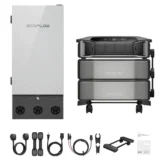 Home battery & solar
 Yard equipment
How to size a generator, choose a mower for your lawn, and decide between battery and gas.
How to size a generator
- List what you want to run in an outage and find each item’s running watts on its label or manual.
- Add the running watts together.
- Find the one item with the biggest starting surge (usually a well pump, sump pump, furnace blower or air conditioner) and add the extra it needs to start.
- Choose a generator whose running watts cover the total and whose starting watts cover the total plus that surge.
Typical loads: refrigerator 700 W running and about 2,200 W to start; sump pump (1/2 HP) about 1,050 W running and 2,150 W to start; furnace blower about 800 W running; window air conditioner (10,000 BTU) about 1,200 W running and 3,600 W to start; a 3-ton central air conditioner about 3,800 W running and up to 11,000 W to start. Use the sizing tool on our home page to add them up.
Standby, portable or inverter
- Home standby generators are installed permanently on a pad, run on your natural gas line or a propane tank, and start by themselves within seconds of an outage through an automatic transfer switch. A licensed electrician and a gas contractor install them, usually with a permit.
- Portable generators deliver the most watts per dollar. To run home circuits they connect through a transfer switch or interlock installed by an electrician. Dual and tri-fuel models also run on propane or natural gas.
- Inverter generators make clean, stable power that is safe for computers and furnace control boards, run quieter, and throttle down at light loads to save fuel.
Always run a portable generator outdoors, at least 20 feet from the house, with the exhaust pointed away from doors and windows. Never connect one to a wall outlet.
Power stations and home batteries
A power station is a battery with a built-in inverter. It runs silently with no fumes, so it can be used indoors, and recharges from the wall, solar panels or a generator. Check two figures: capacity in watt-hours (how long it runs) and AC output in watts (how much it can run at once). Whole-home battery systems connect to your panel through a transfer switch or smart panel installed by an electrician.
Which mower for your lawn
| Lawn size | Good fit |
|---|---|
| Up to 1/4 acre | 20 to 22-inch walk-behind mower, or a robotic mower |
| 1/4 to 1 acre | 21 to 30-inch self-propelled mower, or a 30-inch rider |
| 1 to 2 acres | 42-inch riding mower or zero-turn |
| 2 to 4 acres | 46 to 54-inch zero-turn or lawn tractor |
| More than 4 acres | 54 to 61-inch zero-turn with a fabricated deck |
Measure your narrowest gate before choosing a deck size. On steep slopes a lawn tractor with a steering wheel is often steadier than a zero-turn; check the manufacturer’s maximum slope rating.
Battery or gas
Battery mowers and tools are quiet, start instantly and need no oil, fuel or spark plugs. Their runtime depends on the battery, so check the acreage or minutes per charge, and remember that batteries are often shared across a brand’s tool range. Gas equipment runs as long as you have fuel and suits large or rough properties. California limits the sale of new gas-powered lawn equipment with small engines, so battery models are the choice there.
Robotic mowers
A robotic mower cuts a little every day or two on a schedule and returns to its dock to charge. Boundary-wire models need a wire pegged around the lawn edge; wire-free models navigate with RTK satellite positioning or cameras. Check the rated lawn size and slope, and place the dock near an outdoor outlet.
Still not sure?
Email contact@yardlinepower.com with what you want to power or your lawn size and we help you choose, usually within 1 business day.
